Table of Contents
Open Table of Contents
- Problem with traditional Collection
- Need for Concurrent Collections
- Understanding Concurrent Collection
- CopyOnWriteArrayList
- CopyOnWriteArraySet
- BlockingQueue
- ConcurrentLinkedQueue
- BlockingDeque
- Decision Guide: which to use when
- The ConcurrentHashMap compute family — why it matters
- The blocked thread cost comparison
- Best Practices
- Resources
Problem with traditional Collection
In Traditional Collection object we already have both thread safe and non-thread safe objects.
Non-thread safe classes are: ArrayList, LinkedList, HashMap, etc,.
Problem with Traditional non-thread safe Collection classes: It can be accessed by multiple threads simultaneously and there may be a chance of data inconsistency problem.
We can also make the traditional Collection thread safe by using the utility methods provided by Collections utility class. Example:
Collections.synchronizedList(list)Collections.synchronizedSet(Set)Collections.synchronizedMap(map)
Thread safe classes are: Stack, Vector, HashTable, etc,.
Problem with traditional thread-safe Collection, and Collection classes made thread safe using Collections utility class:
- Performance is not good because every operation, even read, is performed by one thread at a time and it increases waiting time of other threads.
- While one thread is iterating Collection, the other threads are not allowed to modify the Collection object simultaneously, if we try to modify then we will get
ConcurrentModificationException - These problems are with both thread-safe traditional collection and non-thread safe collections which were made thread safe by using the Collections utility class
- Thread safe traditional Collection classes like
Stack,HashTableare thread-safe but there is no concurrency, as only 1 thread will be using it at a time, so low performance.
Example:
List<String> list = new ArrayList<>();
list.add("One");
list.add("Two");
list.add("Three");

Thread readerThread = new Thread(() -> {
	System.out.println("Reader thread started);
	for(String str : list) {
		System.out.println("Reading: " + str);
	}
});

Thread writerThread = new Thread(() -> {
	System.out.println("Modify thread started");
	list.add("Five");
});

readerThread.start();
writerThread.start();

//Output:
//ConcurrentModificationException: only when reader is working and writer tries to update the value
//If writer would have been started first then this issue might not have come
Problems with Traditional Approaches:
- Not Thread-Safe: ArrayList, HashMap, etc. can become corrupted under concurrent access
- Synchronized Wrappers: Collections.synchronizedMap() provides safety but poor performance
- Coarse-Grained Locking: Entire collection locked during any operation
- Iteration Issues: ConcurrentModificationException during concurrent iteration/modification
- Blocking Operations: No built-in support for producer-consumer patterns
To overcome this problem, Concurrent Collection has been introduced in Java 1.5 version.
Concurrent Collections Benefits:
- Thread-Safe: Designed for concurrent access from multiple threads
- High Performance: Fine-grained locking or lock-free algorithms
- Scalable: Performance doesn’t degrade significantly with thread count
- Fail-Safe Iteration: Iterators work on snapshots, no ConcurrentModificationException
- Rich APIs: Specialized methods for concurrent operations
To solve the above code problem using Concurrent Collection:
List<String> list = new CopyOnWriteArrayList<>();
//..
//..
//Same code as above
//..
//..
readerThread.start();
writerThread.start();

//wait for threads to complete execution
readerThread.join();
writerThread.join();

//Now check if modification is done or not
System.out.println(list);
Need for Concurrent Collections
In multithreaded environment multiple threads will write and read shared data, this may lead to data inconsistency or data corruption.
So Concurrent Collection helps prevent data inconsistency or data corruption in multi-threaded environment. And it allows multiple threads to work simultaneously without creating any issues.
Example:
- Problem → In BookMyShow, when only 1 seat is remaining and multiple people are trying to book it at the same time. If both succeeds then 1 seat will be allocated to more than 1 people which is a problem.
- Solution → Synchronized. We can synchronize the access to shared resource – seats – so only one person can book at a time.
- Problem → If only one user books a seat at a time and he takes 10 mins to do that, then 100 people will take
10*100 = 1000 minswhich is equal to 16 hours, to book only 100 tickets. This is a problem as it is taking very long time. - Solution → Concurrent Collection. This allows multiple people to access shared resource at a time without any issues, solving the problem from traditional non-thread-safe Collection and very long execution from synchronized.
Understanding Concurrent Collection
- Concurrent Collections are always thread safe
- Performance is improved because of different locking mechanism
- While one thread is doing read operation other thread can modify the Collection safely
Important concurrent classes/interfaces are:
ConcurrentHashMapCopyOnWriteArrayListCopyOnWriteArraySetBlockingQueue
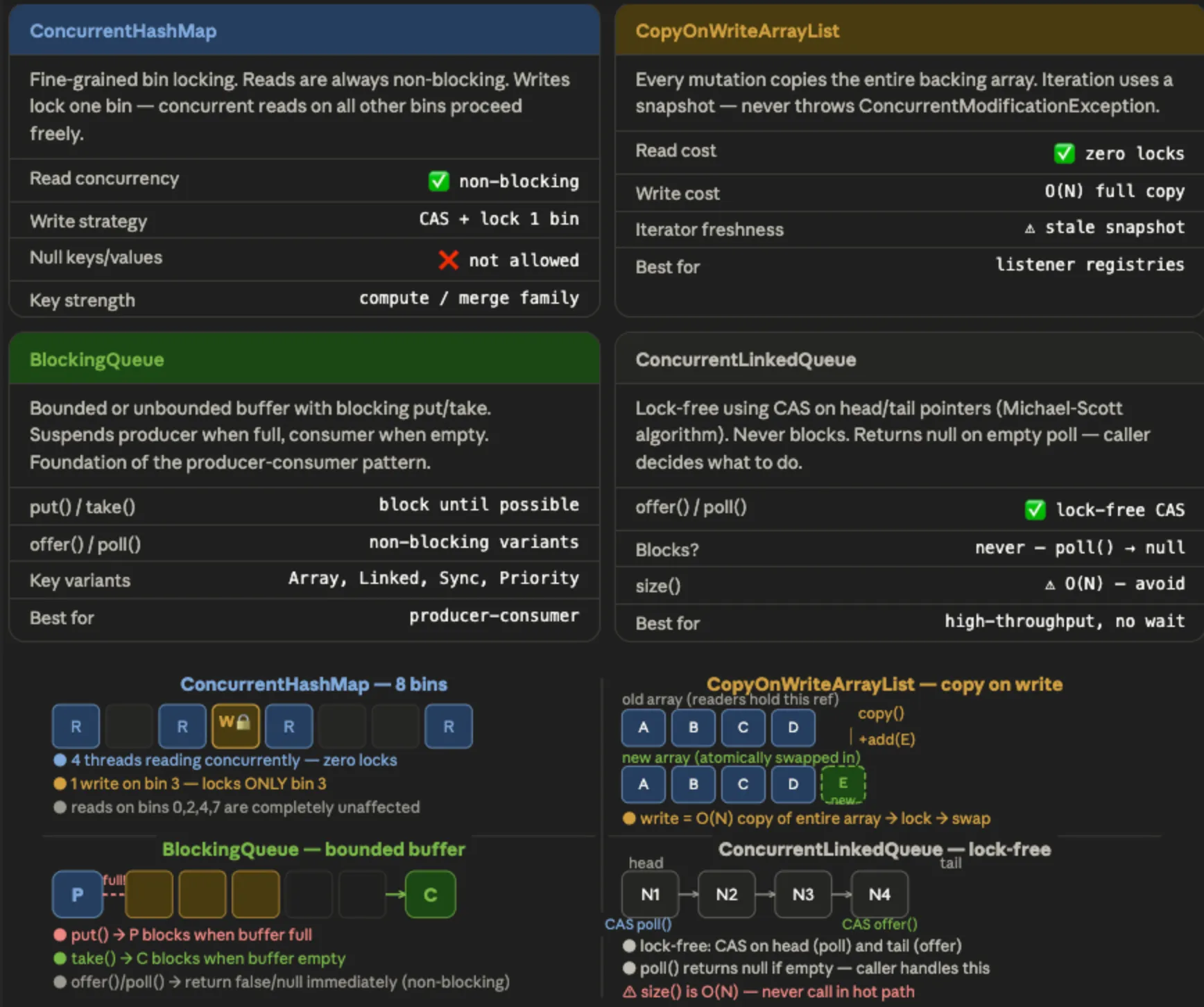
Four distinct tools for four distinct problems.
ConcurrentHashMapmaximizes read throughput with fine-grained bin locking.CopyOnWriteArrayListmakes iteration safe at the cost of expensive writes.BlockingQueuecoordinates producers and consumers through blocking semantics.ConcurrentLinkedQueueeliminates locks entirely with CAS.
ConcurrentHashMap
The ConcurrentHashMap is very similar to the java.util.HashTable class, except that ConcurrentHashMap offers better concurrency than HashTable does.
ConcurrentHashMap does not lock the Map while you are reading from it. Additionally, ConcurrentHashMap does not lock the entire Map when writing to it. It only locks the part of the Map that is being written to, internally.
It allows read operations concurrently and update operations in a thread safe manner
Features of ConcurrentHashMap:
- ConcurrentHashMap internally uses HashTable as its data structure. It is thread safe just like Hashtable. It provides all the functionalities of HashMap except thread safety.
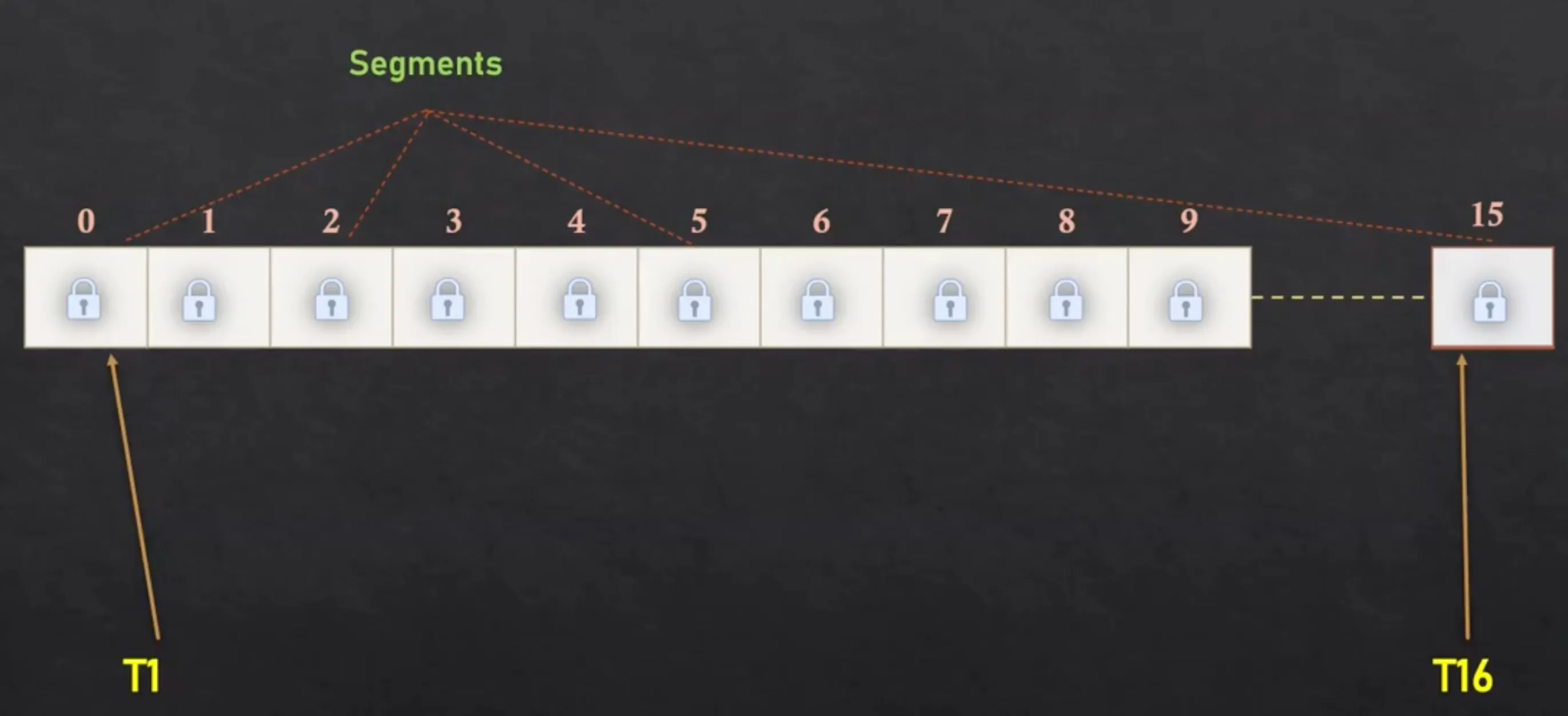
- ConcurrentHashMap internally divides it into segments. Each segment works independently and can be accessed by different reader threads simultaneously. However, each segment can be accessed only by one writer thread at a time. This also means, a concurrent hash map can be accessed by as many writer threads together as there are segments.
- The default level of concurrency is 16. Which means by default, there are 16 segments.
- Read operations don’t require locking of concurrent hash map, where as write operations do require locking.
- Locking is known as segment or bucket locking.
- Concurrent hash map doesn’t allow null key or null values.
Another difference is that ConcurrentHashMap does not throw ConcurrentModificationException if the ConcurrentHashMap is changed while being iterated.
ConcurrentHashMap class hierarchy
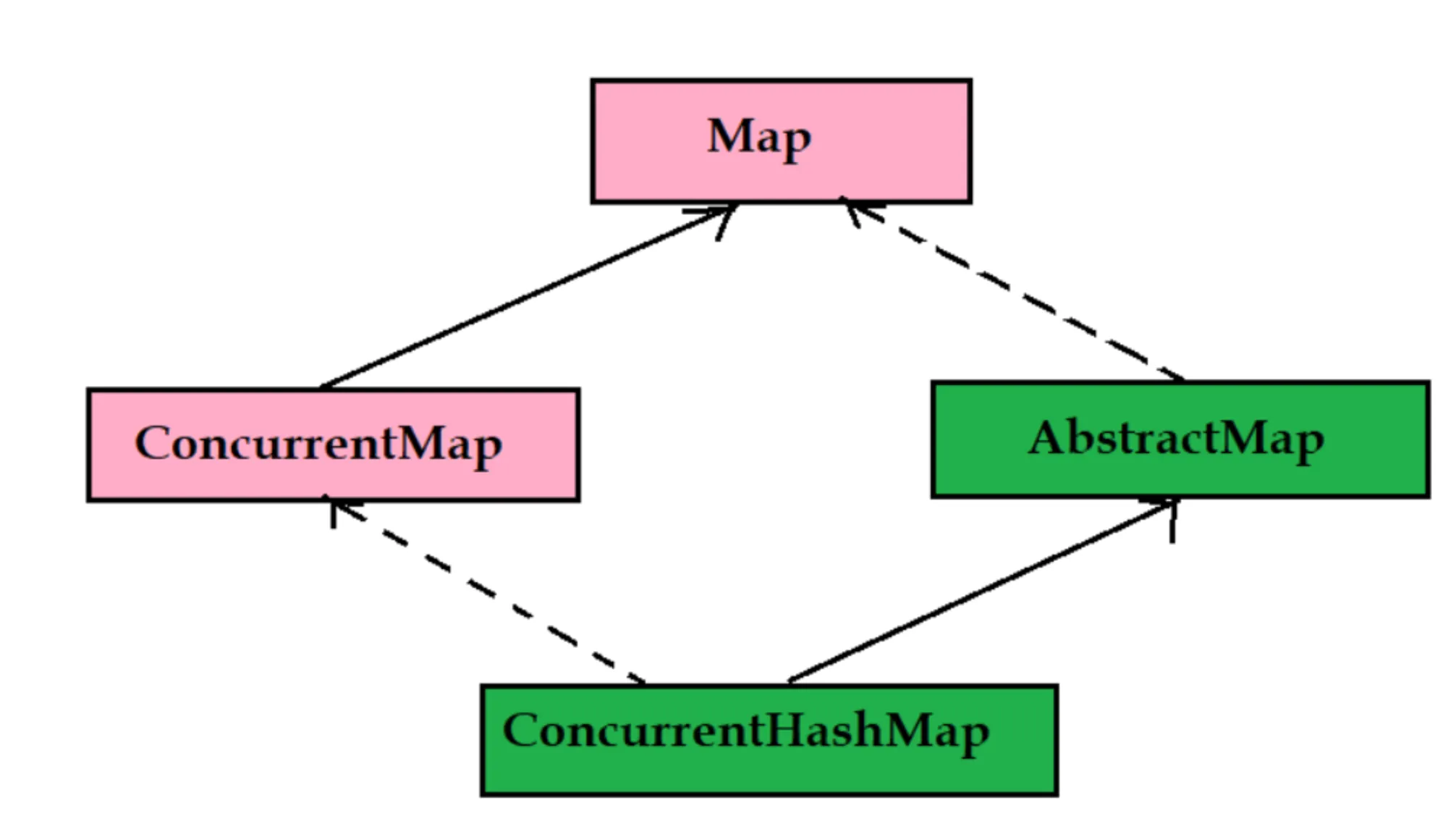
The java.util.concurrent.ConcurrentMap interface represents a Java Map which is capable of handling concurrent access (puts and gets) to it.
The ConcurrentMap has a few extra atomic methods in addition to the methods it inherits from its superinterface, java.util.Map.
Since ConcurrentMap is an interface, you need to use one of its implementations in order to use it. The java.util.concurrent package contains the following implementations of the ConcurrentMap interface:
- ConcurrentHashMap
ConcurrentHashMap operations
- ConcurrentHashMap (Java 8+) uses an array of bins.
- Reads call
get()without any locking — they use a volatile read of the bin’s node chain. - Writes (put, remove) use CAS for empty bins or synchronized on the individual bin’s first node — meaning only one bin is locked at a time and all other bins remain freely accessible.
- The
compute()family is the killer feature: atomic read-modify-write in one operation. - It supports various atomic operations, such as
putIfAbsent,replace, andremove. - These operations are performed atomically without the need for external synchronization.
Here is an example of how to use the ConcurrentMap interface. The example uses a ConcurrentHashMap implementation:
ConcurrentHashMap<String, Integer> map = new ConcurrentHashMap<>();

// ── Basic operations (same as HashMap, fully thread-safe) ─────────
map.put("alice", 1);
map.get("alice"); // non-blocking — no lock at all
map.remove("alice");
map.containsKey("bob");

// ── Atomic conditional operations ─────────────────────────────────
map.putIfAbsent("alice", 1); // only inserts if key absent — atomic. Returns null if succeeds, else returns old value if key already present
map.replace("alice", 1, 2); // only replaces if the given key's current value is 1
map.remove("alice", 1); // only removes if given key's value equals 1


// ── compute family — atomic read-modify-write ─────────────────────
// Only acquires a lock if the method condition -- ifAbsent, ifPresent -- succeeds. After acquiring lock, executes the given lambda to update the value

// computeIfAbsent: create + insert ONLY if key missing
// Classic use: lazily build per-key collections
map.computeIfAbsent("alice", k -> 0); // inserts 0 only if absent
List<String> list = perUserMap.computeIfAbsent("alice", k -> new ArrayList<>());

// computeIfPresent: update ONLY if key exists
map.computeIfPresent("alice", (k, v) -> v + 1); // increment if present

// compute: always called — create if absent OR update if present
map.compute("alice", (k, v) -> v == null ? 1 : v + 1); // init or increment

// merge: simplest counting/accumulation pattern
map.merge("alice", 1, Integer::sum); // set 1 if absent; else sum existing + 1
// ← THE cleanest word-count / frequency-count idiom

// ── Parallel bulk operations (Java 8+) ────────────────────────────
// threshold: min entry count per parallel task (1 = max parallelism)
map.forEach(1, (k, v) -> process(k, v));
long totalScore = map.reduceValues(1, v -> (long) v, Long::sum);
String firstHigh = map.search(1, (k, v) -> v > 100 ? k : null);

// ── Size caveat ───────────────────────────────────────────────────
int approx = map.size(); // may miss in-flight concurrent updates
long better = map.mappingCount(); // returns long — better for large maps


//Runnint concurrent reader and writer threads on hashmap
Thread readerThread = new Thread(() -> {
	System.out.println("Reader thread working:");
	for(String key : map.keySet()) {
		System.out.println("Key: " + key + ", Value: " + map.get(key));
	}
});
readerThread.start();

Thread writerThread = new Thread(() -> {
	System.out.println("Writer Thread working");
	map.put("Ten", 10);
});
writerThread.start();
//No error

//If we change ConcurrentHashMap with HashMap, then it will throw ConcurrentModificaitonException
Fail-safe vs fail-fast
- Traditional collection are fail-fast as they tell the coder immediately when an error comes stating that this thing is not allowed, like in case of concurrent modification exception
- Concurrent collection uses fail-safe and allows the program to run smoothly and at last modification is also performed without any error.
ConcurrentHashMap returns a fail safe iterator. It means, using this iterator, we can modify ConcurrentHashMap while iterating it. Let’s see one example:
public class ConcurrentHashMapExample {

	public static void main(String[] args) {

		ConcurrentHashMap<Integer, String> cMap = new ConcurrentHashMap<>();
		cMap.put(1, "Taj Mahal");
		cMap.put(2, "Qutab Minar");
		cMap.put(3, "Char Minar");

		Iterator<Integer> it = cMap.keySet().iterator();
		while(it.hasNext()) {
			int key = it.next();
			if(key == 2)
				cMap.put(2, "Gateway of India");
			System.out.println(key + " : " + cMap.get(key));
		}
	}
}
In the above example, we saw that we can modify ConcurrentHashMap while iterating it. It became possible because the iterator returned by ConcurrentHashMap is fail safe. Which means we can modify it while iterating.
Avoiding Slipped Conditions
Look at this Java code example:
ConcurrentMap map = new ConcurrentHashMap();

if( !map.containsKey("key1") ) {
     map.put("key1", "value1");
}
Even if both the containsKey() and put() method are both thread safe - the above if-statement construct is not thread safe.
The problem with the above if-construct is that if 2 threads execute the above if-statement simultaneously they may both call map.containsKey("key1") at the same time, they might both receive the answer that the map does not contain the key “key1” - meaning containsKey() returns false. In that case, both threads will continue into the if-statement body, and both insert a value into the ConcurrentMap. The second thread to insert its value will overwrite the value inserted by the first thread.
In the above example, having 2 threads both insert the static value “value1” may not be so big of a problem, but what if the value was computed - based on something the individual thread knows?
The solution to this problem is to use one of the atomic methods putIfAbsent() or computeIfAbsent() instead.
The putIfAbsent() method of the Java ConcurrentMap interface inserts the given key + value pair, if no key + value pair exists for the given key already.
The ConcurrentMap implementation will make sure that only one thread at a time will be allowed to insert a value for the same key. The ConcurrentMap might allow multiple threads to insert key + value pairs for different keys - depending on its internal implementation (e.g. some implementations may only allow multiple concurrent insertions if the key + value pair lands in different “buckets” internally).
The computeIfAbsent() method is similar to the putIfAbsent() method - except it enables you to compute a value to insert for a given key, if no key + value pair is already stored for that key.
Only one thread at a time will be allowed to execute computeIfAbsent() for the same key. If two threads calls computeIfAbsent() for the same absent key, one of the threads will be allowed to compute and insert its value, and the other thread will not compute nor insert any value.
The value to be inserted is computed by the Java lambda expression that you pass in as the second parameter to the computeIfAbsent() method.
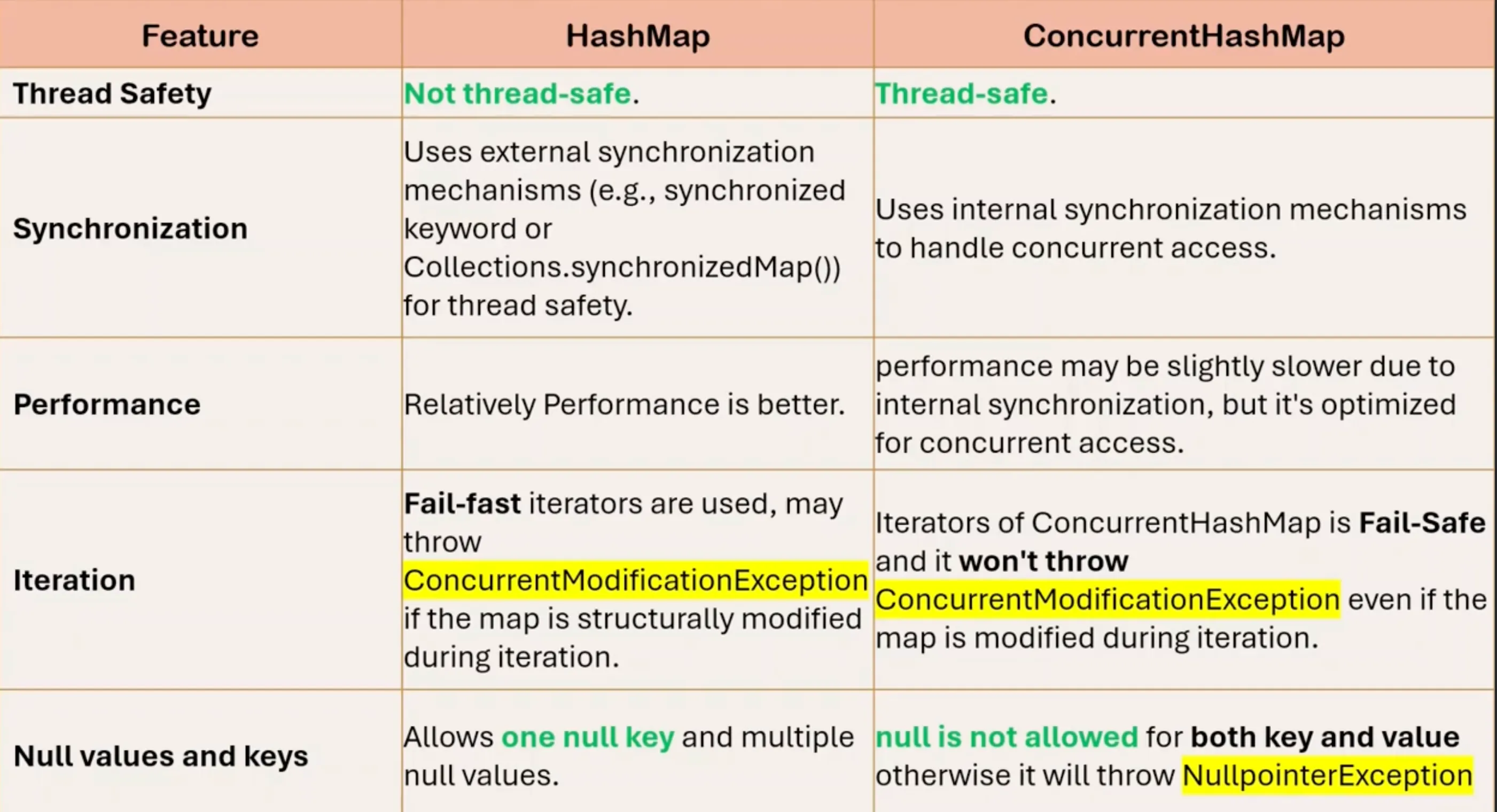
HashMap vs ConcurrentHashMap
Key notes on ConcurrentHashMap
-
✓ The compute family (
computeIfAbsent,merge,compute) is atomic — the function runs exactly once under the bin lock. This makes it safe for counter increment, lazy initialization, and grouping — all in one line. -
⚠ Functions passed to
compute/merge/computeIfAbsentMUST be fast and non-blocking. They run under a bin lock, so a slow function blocks all other operations on that bin. -
⚠ Null keys and null values are NOT allowed —
ConcurrentHashMapuses null as a sentinel for “absent”. UseOptionalor a dedicated null-object if you need to store nulls. -
✓
computeIfAbsentfor building per-key collections is the idiomatic replacement for synchronizedputIfAbsent+get. One atomic operation vs two operations with a race window between them.
CopyOnWriteArrayList
On its working:
The CopyOnWriteArrayList is a thread safe version of ArrayList. If we are making modifications like adding, removing elements in CopyOnWriteArrayList, then JVM does so by creating a new copy of it by the use of Cloning.
Every mutation on CopyOnWriteArrayList (add, remove, set) acquires a lock, copies the entire backing array, applies the change to the copy, then atomically replaces the reference.
We can also add duplicate elements in it.
On Reading:
Multiple threads can read the data from CopyOnWriteArrayList, but only one thread can write data at a particular time.
Reads and iterations hold a reference to the snapshot at the time they started — they never block and never see a ConcurrentModificationException.
The tradeoff: The tradeoff: writes are O(N) and iterators may be stale.
When can it be used:
CopyOnWriteArrayList is costly if used in case of more update operations. Because when changes are made, JVM has to create a cloned copy of the underlying array and add/update elements to it.
CopyOnWriteArrayList is the best choice in multithreading, if there are more read operations.
Code Example:
Code is similar to that of ArrayList and we have already seen it in the “Problems with traditional Collection” section.
Class hierarchy:
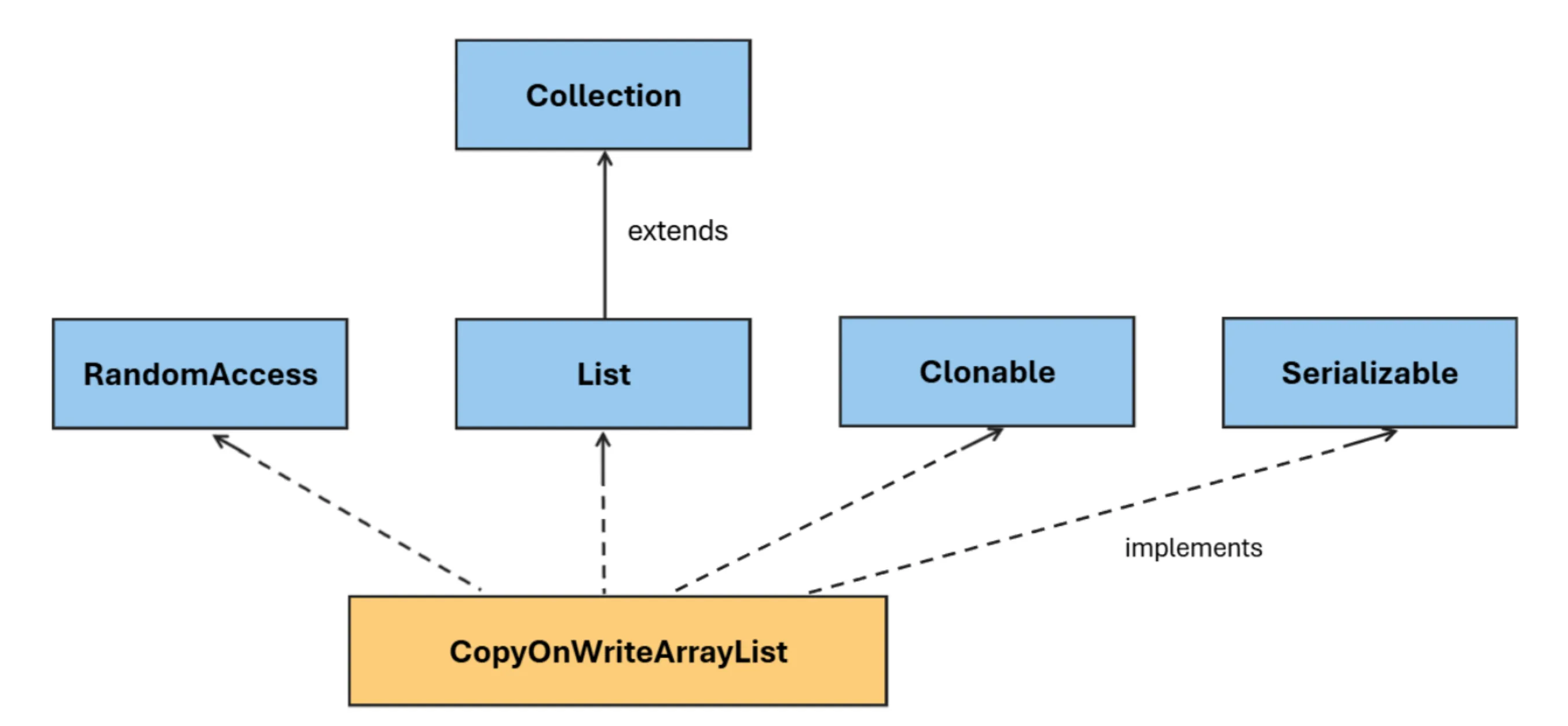
Copy-on-write mechanism, safe iteration, and the staleness tradeoff:
CopyOnWriteArrayList<EventListener> listeners = new CopyOnWriteArrayList<>();

// ── Writes: lock + copy entire array + mutate + atomic swap ───────
listeners.add(newListener); // copies [A,B] → writes [A,B,C] — O(N)
listeners.remove(oldListener); // copies [A,B,C] → writes [A,C] — O(N)
listeners.addIfAbsent(listener); // atomic: add only if not already present
listeners.set(0, updatedListener); // replaces element — still O(N) copy

// ── Reads: non-blocking, zero locking ─────────────────────────────
EventListener first = listeners.get(0); // reads current snapshot, no lock
int count = listeners.size(); // reads current snapshot

// ── Iteration: safe snapshot — NEVER throws ConcurrentModificationException
// Iterator captures a reference to the array at iterator creation time
// New elements added AFTER the iterator was created are NOT visible
// This is correct and expected — iteration always completes safely
for (EventListener l : listeners) {
	l.onEvent(event); // safe — another thread may add/remove without affecting this loop
}

// Explicit snapshot — fire-and-forget event dispatch pattern:
listeners.forEach(l -> l.onEvent(event)); // iterates snapshot, fully concurrent-safe

// ── Stale iterator — by design: ───────────────────────────────────
Iterator<EventListener> ite = listeners.iterator(); // snapshot: [A, B, C]
listeners.add(newListener); // list is now [A, B, C, D]
// ite iterator still sees [A, B, C] — newListener not visible in this iteration

// ── CopyOnWriteArraySet: same concept for Set semantics ───────────
CopyOnWriteArraySet<String> cowSet = new CopyOnWriteArraySet<>();
cowSet.add("handler-1"); // copies the array, enforces uniqueness

// ── Use when / avoid when ─────────────────────────────────────────
// ✓ Use: event listener lists, observer registries, callback registries
// → reads (dispatch) vastly outnumber writes (register/unregister)
// ✗ Avoid: large collections, frequent writes, must see latest data
// ✗ Avoid: hot loop reads — creating iterators on every tight loop iteration
Key notes:
-
✓
CopyOnWriteArrayListis the standard for listener/observer registries because dispatching events (read) happens orders of magnitude more often than registering/unregistering handlers (write). -
⚠ Each write is O(N). A 1000-element list with 100 concurrent writes = 100 × 1000 = 100,000 element copies. For large lists or write-heavy workloads,
ConcurrentLinkedQueueor a lock-based list performs better. -
⚠ The iterator snapshot is intentionally stale. If you need to see the absolute latest list contents in every iteration, you need synchronized(list) + regular ArrayList, not CopyOnWriteArrayList.
-
✓
CopyOnWriteArrayList.addIfAbsent()is the atomic “register once” operation for listeners. It’s thread-safe and idiomatic — no need for double-checked locking or separatecontains()+add()calls.
CopyOnWriteArraySet
- It is a thread safe version of
Set. Insertion order is preserved - Internally implemented by
CopyOnWriteArrayList. Hence similar working - For update operation, it creates a new copy of set and it won’t impact read operations
- It is suitable for scenarios where reads are more frequent than writes
- While one thread is iterating, other threads are allowed to modify the set without getting the
ConcurrentModificationException - It won’t perform remove operation, otherwise it will throw
RuntimeException
Code:
Just update the first line in the CopyOnWriteArrayList code to Set<String> set = new CopyOnWriteArraySet<>();
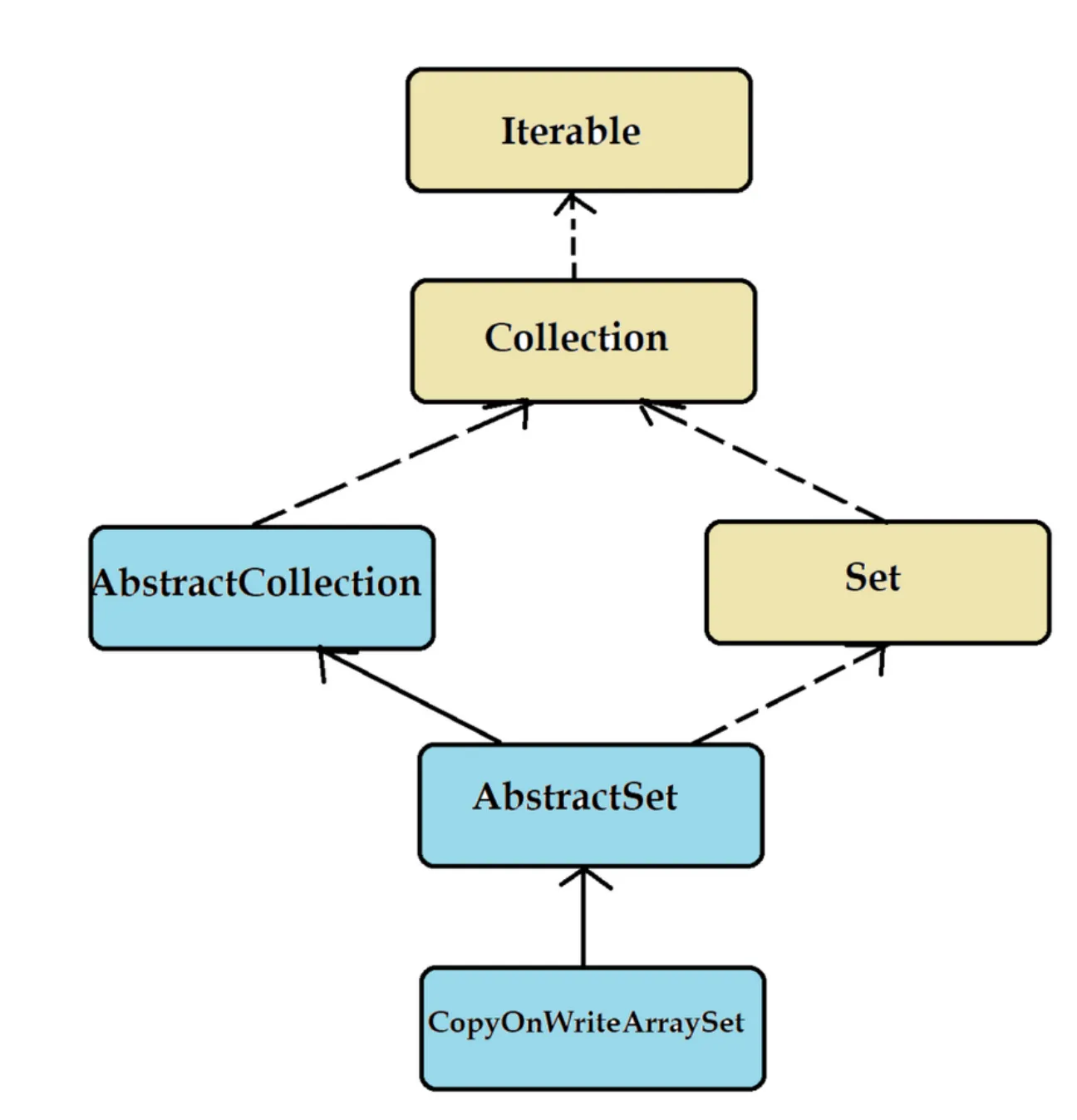
Class hierarchy:
BlockingQueue
BlockingQueue is the backbone of producer-consumer patterns.
The Java BlockingQueue interface, java.util.concurrent.BlockingQueue, represents a queue which is thread safe to put elements into, and take elements out of from. In other words, multiple threads can be inserting and taking elements concurrently from a Java BlockingQueue, without any concurrency issues arising.
The term blocking queue comes from the fact that the Java BlockingQueue is capable of blocking the threads that try to insert or take elements from the queue. For instance, if a thread tries to take an element and there are none left in the queue, the thread can be blocked until there is an element to take. Whether or not the calling thread is blocked depends on what methods you call on the BlockingQueue.
Since BlockingQueue is an interface, you need to use one of its implementations to use it. Each variant makes different tradeoffs between throughput, fairness, ordering, and memory. The java.util.concurrent package has the following implementations of the BlockingQueue interface:
ArrayBlockingQueueLinkedBlockingQueuePriorityBlockingQueueSynchronousQueue
The four-method families give you blocking, non-blocking, time-bounded, and exception-throwing variants for each direction.
LinkedBlockingQueue typically has higher throughput than ArrayBlockingQueue because its separate head/tail locks let producers and consumers operate independently.
BlockingQueue variants — ArrayBQ, LinkedBQ, SynchronousQueue, PriorityBQ:
// ── Four method families: same operation, different failure modes ──
//                Put (add to tail)    Take (remove from head)
// Blocks:        put(e)               take()
// Non-blocking:  offer(e) → bool      poll() → E | null
// Timed:         offer(e, t, unit)    poll(t, unit) → E | null
// Throws:        add(e) throws ISE    remove() throws NSEE

// ── ArrayBlockingQueue: bounded, single lock, fair option ─────────
BlockingQueue<Task> aq = new ArrayBlockingQueue<>(100); // capacity 100
BlockingQueue<Task> fair= new ArrayBlockingQueue<>(100, true); // FIFO fairness

// ── LinkedBlockingQueue: optionally bounded, TWO locks ────────────
// Separate takeLock (head) and putLock (tail) → producers + consumers
// don't contend with each other at all → higher throughput than ArrayBQ
BlockingQueue<Task> lq = new LinkedBlockingQueue<>(); // unbounded ⚠
BlockingQueue<Task> lb = new LinkedBlockingQueue<>(1000); // bounded ✓

// ── SynchronousQueue: zero-capacity, direct hand-off ──────────────
// put() BLOCKS until a consumer is ready to take() — no buffering at all
// Producer and consumer must rendezvous — perfect for direct task handoff
BlockingQueue<Task> sq = new SynchronousQueue<>();
// Used internally by Executors.newCachedThreadPool() for direct task handoff

// ── PriorityBlockingQueue: unbounded, priority-ordered ────────────
// take() always returns the highest-priority element (min heap internally)
BlockingQueue<Task> pq = new PriorityBlockingQueue<>(11,
	Comparator.comparingInt(Task::getPriority));

// ── Producer-Consumer thread-pool worker pattern ──────────────────
BlockingQueue<Task> workQ = new LinkedBlockingQueue<>(500); // bounded!

// Producer (submitter thread):
while (!done) {
	workQ.put(generateTask()); // blocks if 500 tasks queued — natural backpressure
}
workQ.put(POISON_PILL); // signal consumers to stop

// Consumer (worker thread):
while (true) {
	Task task = workQ.take(); // blocks when empty — zero CPU waste
	if (task == POISON_PILL) break;
	processTask(task);
}
Key notes:
-
✓
LinkedBlockingQueueoutperformsArrayBlockingQueueunder high concurrency because it has TWO locks:takeLock(head) for consumers andputLock(tail) for producers. They never contend with each other. -
⚠ Never use new
LinkedBlockingQueue<>()(unbounded) in production. If consumers are slower than producers, the queue grows without limit →OutOfMemoryError. Always specify a capacity bound. -
✓ The poison pill pattern (special sentinel task) is the cleanest shutdown mechanism. Each consumer passes the pill to the next consumer before exiting:
workQ.put(POISON_PILL). N producers → N pills for N consumers. -
✓
SynchronousQueueis the right choice when you want to hand a task directly to a waiting thread with zero buffering.Executors.newCachedThreadPool()uses it — each submitted task directly activates or creates a thread. -
For more on this topic: Java BlockingQueue
ArrayBlockingQueue
LinkedBlockingQueue
SynchronousQueue
PriorityBlockingQueue
DelayQueue
ConcurrentLinkedQueue
ConcurrentLinkedQueue does NOT implement BlockingQueue
ConcurrentLinkedQueue is a non-blocking, thread-safe queue that allows multiple threads to add and remove elements simultaneously without waiting, while LinkedBlockingQueue is a blocking queue that can cause threads to wait when the queue is empty or full. The choice between them depends on whether you need blocking behavior or higher throughput without waiting.
ConcurrentLinkedQueue vs LinkedBlockingQueue
While both LinkedBlockingQueue and ConcurrentLinkedQueue are thread-safe, they operate differently:
-
Blocking vs. Non-Blocking:
LinkedBlockingQueueblocks threads when the queue is empty (or full), ensuring tasks are processed as soon as possible but requiring threads to wait. On the other hand,ConcurrentLinkedQueuenever blocks; it simply returnsnullif no task is available, allowing threads to move on without waiting. -
Use Cases:
LinkedBlockingQueueis ideal when you need precise coordination between threads, such as ensuring tasks are processed in a specific order with waits.ConcurrentLinkedQueue, however, is more suitable for high-throughput scenarios where tasks can be processed as they come in without strict ordering or waiting.
The Importance of Blocking and Non-Blocking Queues
Understanding blocking and non-blocking queues enhances your ability to design efficient, thread-safe systems. Here’s why this knowledge is vital:
-
Inter-Thread Communication: Blocking queues like the
LinkedBlockingQueueare key when you need to manage communication and task flow between different threads, making them perfect for scenarios requiring threads to wait for each other. -
Thread Safety Without Locks: Non-blocking queues like the
ConcurrentLinkedQueueallow concurrent access without the need for traditional locking mechanisms, improving performance in high-throughput applications and reducing the potential for thread contention. -
Scalability: Both queue types contribute to scalable applications that can handle numerous concurrent operations, which is pivotal in modern software architectures such as microservices and real-time data processing.
Understanding ConcurrentLinkedQueue
ConcurrentLinkedQueue uses the Michael-Scott non-blocking queue algorithm. offer() and poll() perform CAS on the tail and head nodes respectively — if the CAS fails (another thread beat them), they retry. No thread ever blocks or holds a lock. This makes it the highest-throughput option under extreme concurrency, but it requires the caller to handle the null-on-empty behavior rather than blocking.
ConcurrentLinkedQueue — lock-free operations, draining, and pitfalls:
Queue<Task> clq = new ConcurrentLinkedQueue<>();

// ── Core non-blocking operations ──────────────────────────────────
clq.offer(task); // always true (unbounded) — lock-free CAS on tail
Task t = clq.poll(); // null if empty — lock-free CAS on head
Task t = clq.peek(); // returns head WITHOUT removing — lock-free
boolean empty = clq.isEmpty(); // O(1), reliable
int n = clq.size(); // ⚠ O(N) — traverses entire list! never in hot path

// ── High-throughput multi-producer pattern ─────────────────────────
// Thousands of threads offering concurrently — CAS retries on contention
// Under low contention: O(1) with no spin. Under high contention: brief spin.
IntStream.range(0, 10_000).parallel()
	.forEach(i -> clq.offer(new Task(i))); // all concurrent, no locks

// ── Draining in a consumer loop ────────────────────────────────────
Task task;
while ((task = clq.poll()) != null) {
	process(task); // stops when queue is empty (poll returns null)
}

// ── Draining a batch ──────────────────────────────────────────────
List<Task> batch = new ArrayList<>(100);
Task item;
while (batch.size() < 100 && (item = clq.poll()) != null) {
	batch.add(item);
}
// Note: ConcurrentLinkedQueue does NOT implement BlockingQueue
//       → no drainTo(), no put(), no take()

// ── ConcurrentLinkedDeque: double-ended version ───────────────────
Deque<Task> cld = new ConcurrentLinkedDeque<>();
cld.offerFirst(urgent); // push to head — high-priority insertion
cld.offerLast(normal); // append to tail — normal insertion
cld.pollFirst(); // remove from head — LIFO or FIFO depending on usage
cld.pollLast(); // remove from tail

// ── CLQ vs BlockingQueue — when to choose each ────────────────────
// ConcurrentLinkedQueue:
// ✓ CPU-bound consumer that never needs to wait
// ✓ Multiple producers + single fast consumer
// ✓ Unbounded is acceptable (or managed externally)
// BlockingQueue:
// ✓ Consumer should sleep when empty (not busy-wait)
// ✓ Need backpressure (bounded put())
// ✓ Producer-consumer with mismatched rates
Key notes:
-
⚠
size()onConcurrentLinkedQueuetraverses every node — it’s O(N) and can return a stale count if concurrent modifications happen during traversal. UseisEmpty() for the empty check. -
⚠
ConcurrentLinkedQueuedoes NOT implementBlockingQueue— there’s no blockingtake()ordrainTo(). If you need to block a consumer thread when the queue is empty, use aBlockingQueueinstead. -
✓ The
while-poll()drain pattern is the standard way to process all available items without blocking. It’s safe under concurrent producers — if a producer adds a new item during the drain, it may or may not be seen (that’s correct behavior). -
✓
ConcurrentLinkedDequeis useful for work-stealing implementations where you want both LIFO and FIFO access. Each “worker” can pop its own deque LIFO (local) while stealers take FIFO (from the other end).
BlockingDeque
LinkedBlockingDeque
Decision Guide: which to use when
Choosing the wrong concurrent collection is one of the most common performance bugs. The decision comes down to four questions: Do you need blocking semantics? How read-heavy is it? Do you need ordering guarantees? Is memory bounded important? This guide maps each scenario to the right tool.
Decision guide — matching each collection to its use case:
// ═══════════════════════════════════════════════════════════════════
// DECISION TREE
// ═══════════════════════════════════════════════════════════════════
//
// Need a Map?
// → ConcurrentHashMap — always. Replaced synchronizedMap() everywhere.
//     ✓ compute/merge for atomic read-modify-write
//     ✗ Don't: Collections.synchronizedMap(new HashMap<>())
//
// Need a List — reads >> writes (listener lists, observer registries)?
// → CopyOnWriteArrayList // ✓ Iteration always safe, zero lock overhead on reads
//     ✗ Avoid if writes are frequent or list is large (> ~100 elements)
//
// Need a Queue — producer/consumer with backpressure and blocking?
// → BlockingQueue (pick a variant):
//     ArrayBlockingQueue: bounded, predictable memory
//     LinkedBlockingQueue: bounded (always specify!), higher throughput
//     PriorityBlockingQueue: ordered by priority, unbounded
//     SynchronousQueue: direct handoff, zero buffering
//
// Need a Queue — non-blocking, high-throughput, caller handles null?
// → ConcurrentLinkedQueue
//     ✓ Lock-free, excellent under many producers
//     ✗ Not a replacement for BlockingQueue if consumer must sleep
//
// Need a Set?
// → ConcurrentHashMap.newKeySet() or Collections.newSetFromMap(new CHM<>())
// → CopyOnWriteArraySet (for small, read-heavy sets)

// ── Common patterns ────────────────────────────────────────────────

// Word frequency count (CHM + merge)
ConcurrentHashMap<String, Integer> freq = new ConcurrentHashMap<>();
words.parallelStream().forEach(w -> freq.merge(w, 1, Integer::sum));

// Thread-safe Set (CHM-backed)
Set<String> concurrentSet = ConcurrentHashMap.newKeySet();
concurrentSet.add("alice");

// Worker pool with bounded queue + backpressure
BlockingQueue<Runnable> tasks = new LinkedBlockingQueue<>(1000);
ThreadPoolExecutor pool = new ThreadPoolExecutor(
	4, 8, 60, TimeUnit.SECONDS, tasks,
	new ThreadPoolExecutor.CallerRunsPolicy() // backpressure on full queue
);

// High-frequency event bus (CLQ + drain batch)
ConcurrentLinkedQueue<Event> events = new ConcurrentLinkedQueue<>();
// Many producer threads: events.offer(e) — lock-free, fast
// Single background thread: drain and process in batches

// ── Antipatterns to avoid ──────────────────────────────────────────
// ✗ Collections.synchronizedList(new ArrayList<>()) — global lock, slow
// ✗ Collections.synchronizedMap(new HashMap<>()) — replaced by CHM
// ✗ new LinkedBlockingQueue<>() without capacity — unbounded, OOM risk
// ✗ clq.size() in a tight loop — O(N) per call!
Key notes:
-
✓
ConcurrentHashMap.newKeySet()is the idiomatic thread-safe Set in Java. It’s backed byConcurrentHashMapand inherits all its concurrency properties — concurrent reads, fine-grained writes. -
⚠ Never use
Collections.synchronizedList()orCollections.synchronizedMap()for new code. They use a single global lock — every operation blocks every other.ConcurrentHashMapandCopyOnWriteArrayListare strictly better. -
✓ When using
BlockingQueueas aThreadPoolExecutorwork queue, always bound it. An unbounded queue means all submitted tasks are always accepted — the pool never creates threads beyond corePoolSize. You lose themaxPoolSizethreads entirely. -
⚠
ConcurrentHashMap.compute()lambdas run under a bin lock — if two keys hash to the same bin, theircompute()calls serialize. Keep lambda bodies short and non-blocking. Long-running lambdas become a global bottleneck.
The ConcurrentHashMap compute family — why it matters
The entire compute family solves the check-then-act problem atomically. Without it, even with a ConcurrentHashMap, this is a race:
// ✗ Race condition — check and act are two separate steps:
if (!map.containsKey("alice")) {    // T1 checks: absent
    map.put("alice", 1);            // T2 also checks: absent — T1 and T2 both put 1!
}

// ✓ Atomic — check and insert happen in one bin-locked operation:
map.computeIfAbsent("alice", k -> 1);
map.merge("alice", 1, Integer::sum);  // cleanest counter pattern
The function you pass to compute/merge/computeIfAbsent runs inside the bin lock — so it’s guaranteed to see a consistent view and no other thread can modify that key concurrently. The consequence: keep these functions fast and non-blocking, or you’ll serialize access to that bin.
The blocked thread cost comparison
| Approach | Thread state while waiting | CPU usage |
|---|---|---|
BlockingQueue.take() | WAITING — thread suspended | 0% |
ConcurrentLinkedQueue.poll() retry loop | RUNNABLE — busy spin | 100% per core |
synchronized collection | BLOCKED — waiting for monitor | 0% |
ConcurrentHashMap.get() | RUNNABLE — no wait at all | minimal |
BlockingQueue is almost always the right choice for producer-consumer because the consumer thread sleeps when there’s nothing to do — it doesn’t waste a CPU core. ConcurrentLinkedQueue requires the application to decide what to do on a null poll, which typically means either busy-waiting (CPU waste) or some external signalling mechanism.
Best Practices
- Choose Appropriately: Match collection to access patterns
- Use Atomic Operations: Leverage
compute(),merge(),compareAndSet() - Avoid Compound Operations: Don’t rely on
size()for decisions - Consider Capacity: Set appropriate initial sizes and limits
- Monitor Performance: Watch for bottlenecks and blocking operations
- Nested Thread Safety: Ensure contained objects are also thread-safe
Common Patterns:
- Producer-Consumer: Use
BlockingQueueimplementations - Cache Implementation:
ConcurrentHashMapwith compute methods - Event Systems:
CopyOnWriteArrayListfor listener lists - Sorted Concurrent Data:
ConcurrentSkipListMapfor ordered access